Meeting the First Bachelors: Rhetorical Analysis (A & E)
Deciding to take AP Language and Composition with Ms. McMahon was one of the most terrifying, all-consuming, life-changing decisions I have ever-- and will ever-- make. When my Sophomore Honors English teacher recommended the class to me I handed in an application willingly, thinking that this class was what most Juniors would take anyways and assuming that it wasn't that big of a deal. However, when Ms. McMahon came to our English class last March to talk about the class I became quite nervous. Most students decided to drop the class altogether before it could begin, or chose not to hand in their applications. Beside myself at this point, I looked into my other options and decided that this class would help me better than any of the other English classes that were offered to Juniors. Although I was scared of the McMonster and the hard work and dedication that her class would entail, she ended up becoming my Chris Harrison and helped lead me through my Lang journey.

When we returned to school after the summer break, my 6th period lang class was instantly hit with a myriad of questions. We were met with tons of new terms and words we simply didn't know or had ever heard of before. Some of the terms like rhetoric, annotate, ethos, pathos, and logos left our ears ringing. It was the first day of Junior year, and I was already stressed beyond control.
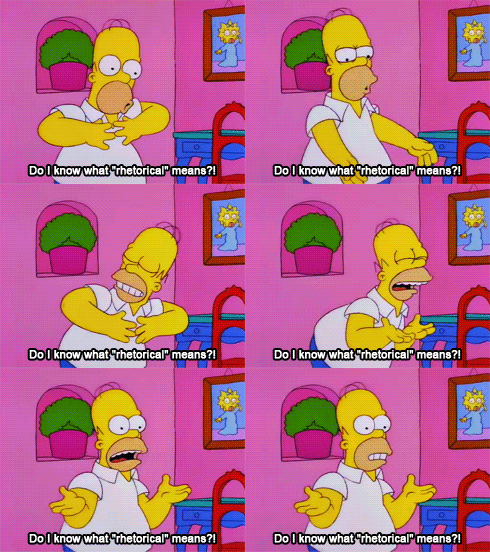
My writing had always been an excelled version of everyone else's in my past English classes. I thrived in Ms. Beecher's class during Freshman year and developed my own style of writing in Mrs. Lemay's class during my Sophomore year. However, my A+'s from Freshman and Sophomore year would not help me anymore...they left me stranded with writing that was in need of DIRE help.
This was when the first Bachelor stepped out of the limo, Rhetorical Analysis.
My mentor, McMahon, introduced me to the RA and it was NOT someone I could see myself liking in the long run. However, like past Bachelorettes, I couldn't just brush one of the Bachelors off without giving them a chance, so into the competition, the RA entered. My initial thoughts of the RA were as follows:
Personality: critical (it liked to point out specific things about pieces of writing and would some times rip them apart to make a point.)
Looks: short, few paragraphs (nothing like what I was used to writing.)
Brains: wide vocabulary, had this thing called a Dual Purpose Thesis...
Misc.: seemed like it was a LOT of work...
Overall, the RA wasn't a TERRIBLE contestant for the AP Lang Bachelorette, it was a bit complicated at parts but seemed to be rewarding. Score: 5/9
When we began studying the RA more in-depth we learned that there was more to it than simply reading a document and citing sentences or strategies in it that helped the author's purpose. Saying this now sounds insane, but, at the time, we had no idea what sentences to cite, what a rhetorical strategy even was, or how to find the author's purpose in a piece of writing.
Then, Annotation stepped out of the limo.
Annotation was a beautiful thing, someone I would definitely want to spend the rest of my life with. It was colorful, organized, and though at times was a lot of work, gosh I loved it.
Personality: lively, chromatic
Looks: colorful, organized (very well-dressed)
Brains: ↓↓↓
Misc.: everything was perfect. Score: 8/9
Annotation was definitely something that I wanted to invest my time in. My colorful personality and love for organization fluttered at the sight of it and I couldn't wait to learn more.
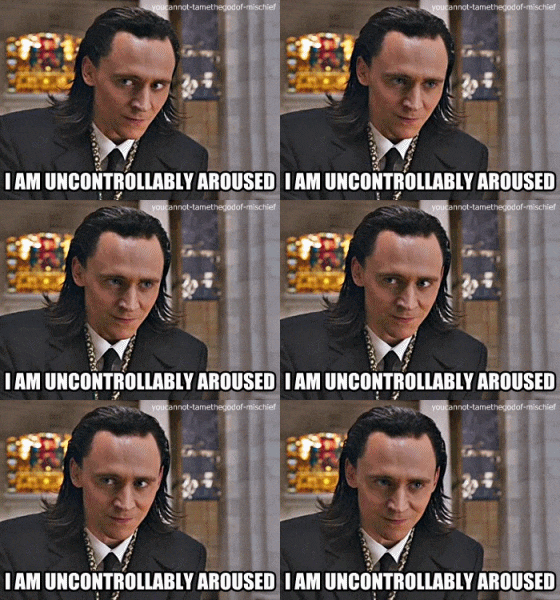
I soon discovered just how much work annotating would be in order to write a decent RA, and my heart sunk a little... McMahon had us annotate a piece and I had no idea what I was doing. The results are as follows.
I soon realized that annotating like that wasn't going to get me anywhere and soon we were really "out here" annotating like a pro.
Once I became a pro at annotating to the best of my ability, it came time for the actual writing of the RA's. At first, this was a struggle of mine. Although I received a 7 on my first RA I wasn't really affected by the high score because I didn't understand why I had received it. It's one thing to receive a high score and know that you are deserving of it and it is another to receive a high score and have absolutely no idea what you did to receive it.
After many trial and errors and many, MANY failures of dual-purpose theses, poor examples of strategies and more, I finally felt deserving of the 7s and 8s I began scoring on my RAs, and that was something to be proud of. McMahon helped me so much with my RA writing throughout the year. From the impromptu run-up-and-put-you-thesis-on-the-board activities to sitting with us when she had time and reading and evaluating out writing, I became aware of myself as a writer and was able to not just be able to pull an RA out of my ass on a Sunday night when I had the whole weekend to write one, I was able to actually comprehend and create a score of 8 on my RAs by the end of the year.
When we returned to school after the summer break, my 6th period lang class was instantly hit with a myriad of questions. We were met with tons of new terms and words we simply didn't know or had ever heard of before. Some of the terms like rhetoric, annotate, ethos, pathos, and logos left our ears ringing. It was the first day of Junior year, and I was already stressed beyond control.
My writing had always been an excelled version of everyone else's in my past English classes. I thrived in Ms. Beecher's class during Freshman year and developed my own style of writing in Mrs. Lemay's class during my Sophomore year. However, my A+'s from Freshman and Sophomore year would not help me anymore...they left me stranded with writing that was in need of DIRE help.
This was when the first Bachelor stepped out of the limo, Rhetorical Analysis.
My mentor, McMahon, introduced me to the RA and it was NOT someone I could see myself liking in the long run. However, like past Bachelorettes, I couldn't just brush one of the Bachelors off without giving them a chance, so into the competition, the RA entered. My initial thoughts of the RA were as follows:
Personality: critical (it liked to point out specific things about pieces of writing and would some times rip them apart to make a point.)
Looks: short, few paragraphs (nothing like what I was used to writing.)
Brains: wide vocabulary, had this thing called a Dual Purpose Thesis...
Misc.: seemed like it was a LOT of work...
Overall, the RA wasn't a TERRIBLE contestant for the AP Lang Bachelorette, it was a bit complicated at parts but seemed to be rewarding. Score: 5/9
When we began studying the RA more in-depth we learned that there was more to it than simply reading a document and citing sentences or strategies in it that helped the author's purpose. Saying this now sounds insane, but, at the time, we had no idea what sentences to cite, what a rhetorical strategy even was, or how to find the author's purpose in a piece of writing.
Then, Annotation stepped out of the limo.
Annotation was a beautiful thing, someone I would definitely want to spend the rest of my life with. It was colorful, organized, and though at times was a lot of work, gosh I loved it.
Personality: lively, chromatic
Looks: colorful, organized (very well-dressed)
Brains: ↓↓↓
Misc.: everything was perfect. Score: 8/9
 |
| The brains of Annotation |
I soon discovered just how much work annotating would be in order to write a decent RA, and my heart sunk a little... McMahon had us annotate a piece and I had no idea what I was doing. The results are as follows.
 |
| A poor example of annotating |
I soon realized that annotating like that wasn't going to get me anywhere and soon we were really "out here" annotating like a pro.
 |
| My best, and most effective annotations |
"Desmond uses Karen as his argument to persuade the audience into seeing there are both advantages and disadvantages to screening. Through Karen, Desmond established ethos and logos, two very important factors to persuasion, especially when it is a situation as important and serious as this. With lots of money on the line, landlords need to know the facts, and they need to have trust and confidence in the person that they are receiving the facts from. Overall, Desmond supports his claims with evidence and facts, and uses stylistic elements such as Karen to show appeals and power to the words and ideas that are expressed."
After many trial and errors and many, MANY failures of dual-purpose theses, poor examples of strategies and more, I finally felt deserving of the 7s and 8s I began scoring on my RAs, and that was something to be proud of. McMahon helped me so much with my RA writing throughout the year. From the impromptu run-up-and-put-you-thesis-on-the-board activities to sitting with us when she had time and reading and evaluating out writing, I became aware of myself as a writer and was able to not just be able to pull an RA out of my ass on a Sunday night when I had the whole weekend to write one, I was able to actually comprehend and create a score of 8 on my RAs by the end of the year.

Comments
Post a Comment